I've been reading good flyfishing books more than actually flyfishing these days. Zane Grey's Tales of Fishes and the final chapters of Death, Taxes and Leaky Waders by John Gierach have given me hours of great pleasure. I learn something new with each story.
Today I drove south to Purdy Spit near Gig Harbor for a day of chasing resident Coho and searun cutthroat trout. Despite morning fog, the day turned out to be a beautful, but chilly, post-Thanksgiving day.
Last night I drew the tidal chart (below) on my right hand so that I could remember. High tide today is 2:39 and the sun sets around 4:30. I fished from noon to sunset -- so incoming and outgoing.
I strung up my 9-foot, 6-weight with one of Leyland Miyawaki's poppers. To be honest, I've never caught a fish on one of his famous poppers, but I have used it successfully as a search pattern. In other words, it has helped me to find fish but never to catch one.
Out at Purdy, there was already 5-6 flyfishers -- part of what looked like a group. They were friendly but didn't seem to be hooking up.
Fifteen minutes after my first cast, I noticed a small swirl just behind my popper, which I worked just about like a top-water lure for bass. I stopped for a split second and then resumed. Slam! Fish on. It was just about 30 feet from me and so I saw the take pretty well. I stipped him in and used the net to keep the fish in the water. This fish was about 13 inches, relatively small but an enthusiastic fighter.
I believe this was my first resident Coho and it was defintely my first saltwater fish on a popper. Sorry the photos (below) aren't better.
A few minutes later I had another, bigger swirl, but no cigar.
Meanwhile, dark old Chum were splashing and jumping all around. I tried a few times but they are not very interested in feeding at this stage of their lives.
I had several more takes during the day on a beach fly and a scud of some sort. But alas, my first would be my last.
Later this week I plan to fish with my dad in Oklahoma. The weather looks pretty good.
Sunday, November 25, 2012
Saturday, November 10, 2012
Chum
With the sun shining, the winds low and out of the North, I headed out for an afternoon of fishing. We had a lot of rain in October, but it's dried up a bit and the rivers have been falling.
I took 3 rods today -- a 5-, 6- and 7-weight. I didn't have a grand plan, but with my son occupied and the girls traveling I had a rare expanse of time.
My greatest interest was to hunt steelhead, and I knew the "S" rivers were the ones to hunt. So I drove north up the Snoqualmie to the Skykomish. I parked at Al Borkin Park and fished a quarter-mile gravel bar but no luck. Lots of fishermen out, but I didn't see any action. (Cfs was right at 3,000).
As the sun sinking, I headed back south to my spot beneath the Fall City bridge on the Snoqualmie. I took my 5-weight thinking I would just enjoy fishing for small cutts. Nope, nothing. The spot where I know the cutts always hang out was desolate.
Then a funny thing happend.
I saw a rather large surge near my tiny little nymph. I tried again and saw another huge swirl. I could hardly believe my eyes when I looked up and saw a huge fish head stick straight up out of the water and (seemingly) look at me.
Chum salmon! Lots of them.
I hustled back to the car and grabbed my 7-weight and tied on a fly I bought two weeks ago at Patrick's Fly Show. The proprietor there told me chum really dig this smallish, green dumbell-eyed fly (below).
He was right. On the first cast they ate it up. These fish must be 20 pounds. They jump and splash around in the water like a labrador retriever. That's probably why they are called dog salmon.
They are also like a dog in that they grab the line for a game of tug-of-war and then just let loose when they are done playing.
I hooked plenty and had a decent little fight but never brought one to hand. I brought several to the surface but they seemed to just let go. They don't run with the line, they just sit there and hold on tight.
A few weeks ago I fished the South Sound, where I saw enormous Chum right up on the beach leaping from the water. One jumped completely out of the water not 3 feet from me. But try as I might, they would take nothing. This is why I stopped by Patrick's to learn what they would take.
To the uninitiated, the quick way to know Chum are in the area is big, loud splashes right next to the beach. These fish are fearless.
No wonder the usual cutts were gone. They've been pushed out.
Priorities for end of this year are steelhead and some more sea-run cutts. And later this month I will be in Oklahoma and hope to catch a variety there.
I took 3 rods today -- a 5-, 6- and 7-weight. I didn't have a grand plan, but with my son occupied and the girls traveling I had a rare expanse of time.
My greatest interest was to hunt steelhead, and I knew the "S" rivers were the ones to hunt. So I drove north up the Snoqualmie to the Skykomish. I parked at Al Borkin Park and fished a quarter-mile gravel bar but no luck. Lots of fishermen out, but I didn't see any action. (Cfs was right at 3,000).
As the sun sinking, I headed back south to my spot beneath the Fall City bridge on the Snoqualmie. I took my 5-weight thinking I would just enjoy fishing for small cutts. Nope, nothing. The spot where I know the cutts always hang out was desolate.
Then a funny thing happend.
I saw a rather large surge near my tiny little nymph. I tried again and saw another huge swirl. I could hardly believe my eyes when I looked up and saw a huge fish head stick straight up out of the water and (seemingly) look at me.
Chum salmon! Lots of them.
I hustled back to the car and grabbed my 7-weight and tied on a fly I bought two weeks ago at Patrick's Fly Show. The proprietor there told me chum really dig this smallish, green dumbell-eyed fly (below).
He was right. On the first cast they ate it up. These fish must be 20 pounds. They jump and splash around in the water like a labrador retriever. That's probably why they are called dog salmon.
They are also like a dog in that they grab the line for a game of tug-of-war and then just let loose when they are done playing.
I hooked plenty and had a decent little fight but never brought one to hand. I brought several to the surface but they seemed to just let go. They don't run with the line, they just sit there and hold on tight.
A few weeks ago I fished the South Sound, where I saw enormous Chum right up on the beach leaping from the water. One jumped completely out of the water not 3 feet from me. But try as I might, they would take nothing. This is why I stopped by Patrick's to learn what they would take.
To the uninitiated, the quick way to know Chum are in the area is big, loud splashes right next to the beach. These fish are fearless.
No wonder the usual cutts were gone. They've been pushed out.
Priorities for end of this year are steelhead and some more sea-run cutts. And later this month I will be in Oklahoma and hope to catch a variety there.
Sunday, October 7, 2012
Rock-tober
When the water is this clear, and the levels this low, you find little pebble beaches submerged in just the right location. The footing is perfect. I found just the spot this afternoon around 4 pm on the Middle Fork of the Snoqualmie.
With water levels this low, white gleaming boulders are exposed. It's Rock-tober.
Further upstream, alongside a pool where the water was glassy and the fish were rising, I had tied on some fluorocarbon tippet and a Blue Winged Olive. I was putting the fly in the center of the ring, but there were no takers. I packed up, drove further downstream and took up my position at the head of a pool. Most months of the year this spot is part of a waterfall.
I cast to a nearby spot a couple of times as I scanned the water for rises. I was still sizing up the situation when I cast a little further out and noticed the current took my dry fly into the depths. Before I could get my bearings I felt a strong tug and my 5-wt bowed and arched. A nice, bright rainbow ran and lept.
Finally, aftera bit of a slump, I had a nice 12-inch wild rainbow in the net.
It's been a longtime since I checked the USGS streamflow. The Middle Fork at my location was at 150 CFS and still dropping. Temperatures were in the low 70s. We have had around 70 days of dry weather. We have a burn ban underway after wildfires struck the western slope of the Cascades, a rarity.
Fishing has been tough. Today was a good bounce back. I am planning a trip with the Steelhead guide J.D. Love to the Grande Rhonde later this month. Fingers crossed!
With water levels this low, white gleaming boulders are exposed. It's Rock-tober.
Further upstream, alongside a pool where the water was glassy and the fish were rising, I had tied on some fluorocarbon tippet and a Blue Winged Olive. I was putting the fly in the center of the ring, but there were no takers. I packed up, drove further downstream and took up my position at the head of a pool. Most months of the year this spot is part of a waterfall.
I cast to a nearby spot a couple of times as I scanned the water for rises. I was still sizing up the situation when I cast a little further out and noticed the current took my dry fly into the depths. Before I could get my bearings I felt a strong tug and my 5-wt bowed and arched. A nice, bright rainbow ran and lept.
Finally, aftera bit of a slump, I had a nice 12-inch wild rainbow in the net.
It's been a longtime since I checked the USGS streamflow. The Middle Fork at my location was at 150 CFS and still dropping. Temperatures were in the low 70s. We have had around 70 days of dry weather. We have a burn ban underway after wildfires struck the western slope of the Cascades, a rarity.
Fishing has been tough. Today was a good bounce back. I am planning a trip with the Steelhead guide J.D. Love to the Grande Rhonde later this month. Fingers crossed!
Saturday, September 22, 2012
Lake Crescent
My year one anniversary of really learning to flyfish is this month. I still need to reflect on and write about that. It's been an amazing year learning to cast, read water, scout new locations, study fish, etc.
My last two adventures have not been very productive, however. I fished the Cedar River last weekend. I managed to slip away Saturday late afternoon. Water levels were low but it appeared to me that they were releasing water from the dam because the flow was a little more pushy than I had remembered.
I used an Elk Hair Caddis and caught little 10-inch rainbows. Beautiful, feisty little fish. As I waded downstream hoping to catch a feeding frenzy or at least a nice sized, my line got caught in a large tree stump that jammed into the middle of the stream. Rather than lose my fly, I waded out to dislodge the little bugger. Slippery rocks and pushy water caused me to force it more than I normally would. I pulled the line and heard a snap.
Snap!
The third segment of my wonderful Trout Unlimited 5-wt Winston rod snapped. It's the first time I've broken any equipment in this first intensive year of flyfishing. I wasn't upset but was disappointed that I didn't simply close the fly. I am now in touch with the Winston rod manufacturers. I will need to ship the whole rod back so they can customize the replacement. Because the rod is registered it should cost just about $50 plus shipping and handling.
On a happier note, I chaperoned my daughter's 7th grade school trip to Lake Crescent, nestled in the Olympic National Park. Below is a photo I took the first evening looking West.
My last two adventures have not been very productive, however. I fished the Cedar River last weekend. I managed to slip away Saturday late afternoon. Water levels were low but it appeared to me that they were releasing water from the dam because the flow was a little more pushy than I had remembered.
I used an Elk Hair Caddis and caught little 10-inch rainbows. Beautiful, feisty little fish. As I waded downstream hoping to catch a feeding frenzy or at least a nice sized, my line got caught in a large tree stump that jammed into the middle of the stream. Rather than lose my fly, I waded out to dislodge the little bugger. Slippery rocks and pushy water caused me to force it more than I normally would. I pulled the line and heard a snap.
Snap!
The third segment of my wonderful Trout Unlimited 5-wt Winston rod snapped. It's the first time I've broken any equipment in this first intensive year of flyfishing. I wasn't upset but was disappointed that I didn't simply close the fly. I am now in touch with the Winston rod manufacturers. I will need to ship the whole rod back so they can customize the replacement. Because the rod is registered it should cost just about $50 plus shipping and handling.
On a happier note, I chaperoned my daughter's 7th grade school trip to Lake Crescent, nestled in the Olympic National Park. Below is a photo I took the first evening looking West.
I was excited for the experience with my daughter and her classmates, but I was also excited to learn that there is a rare sub-species of rainbow trout in Lake Crescent called the Beardslee trout. One of the camp counselors told me that he routinely catches 14-15 inchers, and he told me where to look.
In between programs and during free time, I would literally sprint down the lake shore looking for rises. The counselor said to use large stimulators. At the mouth of Barnes Creek I found several rises near sunset on the first night. While searching the water for the next rise I felt a couple of good strong strikes, but never managed to bring one in. I got several follows, but that was about all the action over the course of several days. The weather shifted and the fish quit biting.
While hiking up Storm King Mountain on the second day I snapped the photo below of Lake Crescent from the trail.
Monday, September 3, 2012
A Sunny September Sunday
Thomas sat on a VW-sized boulder in the late afternoon sun, and told me the "king of the pool" was right behind yonder rock.
Having bushwacked through a fast-descending mountainside trail and crossed the Middle Fork of the Snoqualmie, I was eager to fish. I barely heard his practiced advice as I started casting to a seam in the middle of the river, which this time of year is a very pleasant 200 cfs. Temperatures were in the mid-70s around 3:30 pm with light winds.
I quickly caught plenty of 8- and 10-inch cuttthroat and rainbows. Thomas had brought us to a series of very nice pools.
To use an over-used phrase, the water was gin clear and trout were rising nicely to dry flies. Nothing better.
Thomas (below) had lent me his 3-wt trout rod and he was using his brand new bamboo rod, which has quite a provenance (perhaops another time).
From the depths darted a good-sized trout like a shark in some Hollywood film. He snatched the fly and dove down behind the rock. I set the hook and watched with great excitement as the largest rainbow I've ever pulled out of the Snoqualmie dove, jumped, banked right and left and ultimately landed in my net (see below).
Having bushwacked through a fast-descending mountainside trail and crossed the Middle Fork of the Snoqualmie, I was eager to fish. I barely heard his practiced advice as I started casting to a seam in the middle of the river, which this time of year is a very pleasant 200 cfs. Temperatures were in the mid-70s around 3:30 pm with light winds.
I quickly caught plenty of 8- and 10-inch cuttthroat and rainbows. Thomas had brought us to a series of very nice pools.
To use an over-used phrase, the water was gin clear and trout were rising nicely to dry flies. Nothing better.
Thomas (below) had lent me his 3-wt trout rod and he was using his brand new bamboo rod, which has quite a provenance (perhaops another time).
After awhile, I started eying the same spot Thomas had seen immediately upon arrival. His words came back to me, and I cast over the top of currents moving at different speeds and my fly landed just behind a large rock with a nice pool behind it. I didn't quite like the location or the presentation so I cast again.
From the depths darted a good-sized trout like a shark in some Hollywood film. He snatched the fly and dove down behind the rock. I set the hook and watched with great excitement as the largest rainbow I've ever pulled out of the Snoqualmie dove, jumped, banked right and left and ultimately landed in my net (see below).
I can't even count the number of fish we caught during 4 very active hours on the water. I got my share of small and medium sized cutts and bows. I learned a lot from Thomas and am very appreciative. Hopefully we can do it again another time.
Thursday, August 23, 2012
Stripers!
Last night I wrote about my near-miss with a big bluefish and the lack of striped bass in August. I also wrote about my current book, The Longest Silence, by Thomas McGuane.
As I lay in bed last night reading McGuane's chapter about his fishing trip to the Elizabeth Islands just off Woods Hole, where I am staying, I got a text from my friend Mark. It read, simply, "5 am?"
He had figured out the bite is on at first light in Quick's Hole, a passage between Buzzards Bay and Vineyard Sound that is larger than but behaves very much much like a river.
I eagerly replied, "yes," and continued reading.
We moved on to Robinson's Hole, the next island over.
"This is what we dream of," I told Mark.
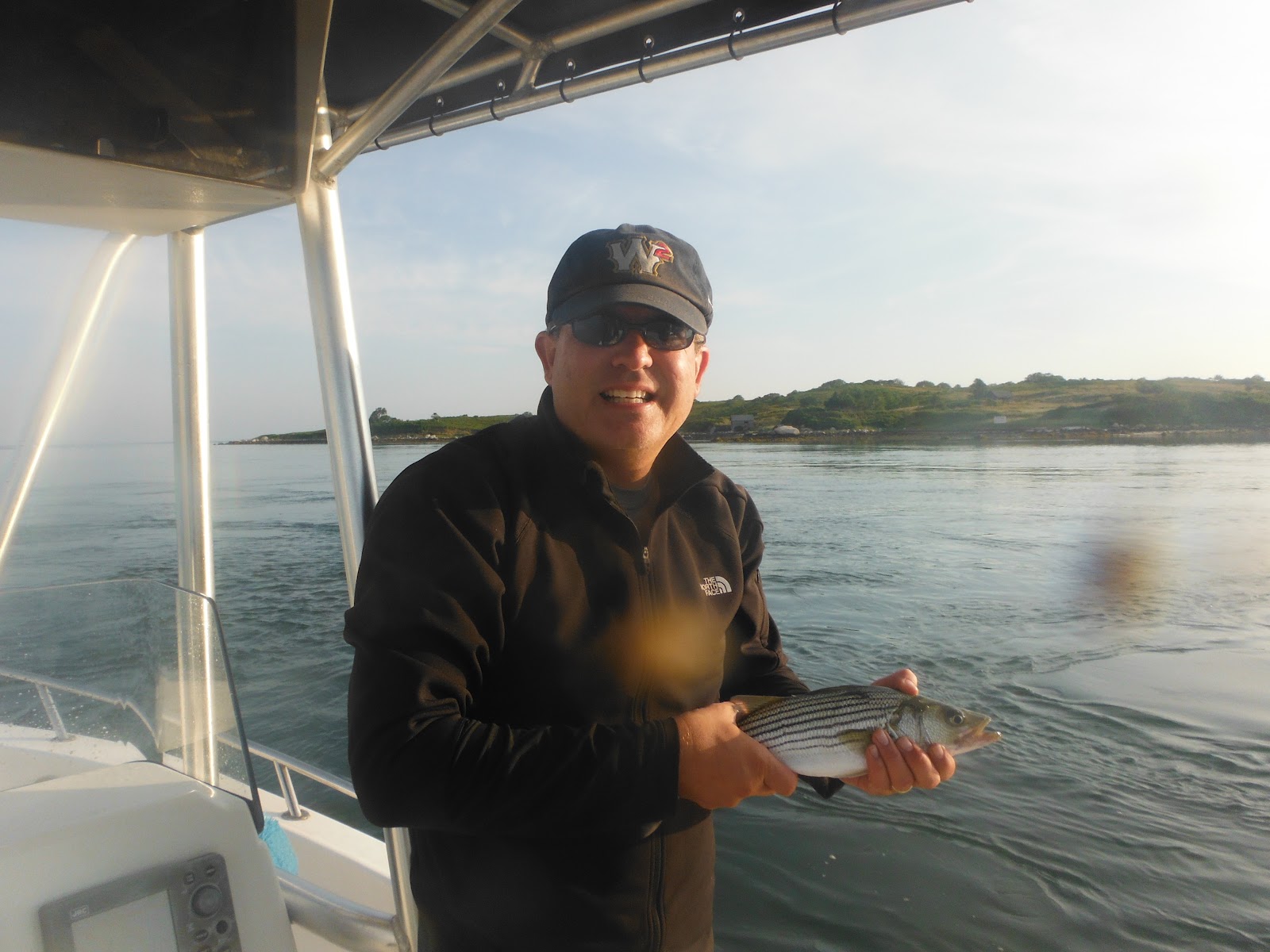
Sea birds were all around us and the fish were feeding in a frenzy right next to the rocky bank. I cast into the middle of the frenzy and finally, a good solid take from a fish I could handle with the right test line. I hauled in a beautiful striped bass. This was not the 28 pounder you see in those fish magazines, but it was a respectable striper caught on a fly.
I hooked another striper in the same spot, but alas that was it. Just as McGuane had written, "a single striped bass."
As I lay in bed last night reading McGuane's chapter about his fishing trip to the Elizabeth Islands just off Woods Hole, where I am staying, I got a text from my friend Mark. It read, simply, "5 am?"
He had figured out the bite is on at first light in Quick's Hole, a passage between Buzzards Bay and Vineyard Sound that is larger than but behaves very much much like a river.
I eagerly replied, "yes," and continued reading.
Dave ran us through Quick's Hole between Pasque and Nashawena and pulled us into a beautiful, quiet bay on the north side of Nashawena."So often the books and fish stories we read are about places distant and unlikely to be visited. Yet, this account was just a few miles and a few hours away for me.
Dave spotted a school of stripers...We had tied on Clouser Minnows, a pattern of nearly universal effectiveness, and striped bass see them as tremendous opportunity.In a beautiful passage, McGuane writes, "I, often confined by riverbanks, was fascinated by this wide-angled view. I soon was made comfortable by our fishing along the rocks, the ocean gulping and foaming around their bases. It looked right when a big green-and-white Deceiver dropped into this turmoil and was drawn into this fishy darkness."
I slept well all night, with all the windows open so the fog could creep around my bedclothes and I could better hear the sonorities of the sea buoy. All night long I received cheerful visits from family ghosts and remembered how I once longed for a single striped bass.I drifted off to sleep myself and was in Quicks Hole -- a good 30 minute sprint from Falmouth Harbor -- by 5:50 the next morning. The sea birds were diving and the fish erupting all around us. Having lost my Deceiver to the big bluefish the night before, I had rigged up with a large pink Clouser and a stronger test line. I hooked one fish but he got away. I cast and cast but could not entice another fish. Suddently the bite was off.
We moved on to Robinson's Hole, the next island over.
"This is what we dream of," I told Mark.
Sea birds were all around us and the fish were feeding in a frenzy right next to the rocky bank. I cast into the middle of the frenzy and finally, a good solid take from a fish I could handle with the right test line. I hauled in a beautiful striped bass. This was not the 28 pounder you see in those fish magazines, but it was a respectable striper caught on a fly.
I hooked another striper in the same spot, but alas that was it. Just as McGuane had written, "a single striped bass."
Wednesday, August 22, 2012
On the Cape
I am well into my second week on Cape Cod. The Cape League baseball season ended in dramatic fasion (CodBall post still to come), and I have been fishing quite a bit.
August is not prime fishing time on the Cape. The mighty Bluefish are generally plentiful but even they have gone on vacation. The striped bass are the main attraction but they are much further up-Cape and not very active this time of year.
So I have been planning, pondering, casting, changine flies, reading fishing literature and learning a lot about saltwater flyfishing.
My tally at this point is two small Bluefish landed, two bluefish hooked (not landed) and possibly the biggest fish I've ever hooked (got away).
Temperatures were soaring when we got here but things have cooled off. The first morning, my friend Mark and I went out early in the morning on his boat. We found seagulls diving after baitfish, and we cast into that madness but I failed to land anything. Mark threw a lure out on a spinrod and landed a nice smallish bluefish. the school was thin so we headed up-Cape to Waquoit where I hooked a small bluefish and had a couple of nice takes but no fish landed.
The next day, I decided to head out on my own along the rocky shore of Nobska Lighthouse point on Martha's Vineyard Sound. Within three casts I had a small bluefish landed. I used a sinking tip with a small pink clouser. A half hour later I had a larger bluefish almost to hand after casting 60-70 feet offshore toward a large rock. The fish threw the hook just at the last minute, which is fine.
Then, nothing.
I returned several times at high tide, low tide, night and day. Nothing.
Well, not nothing. I have gotten a lot of cuts and bruises. Fishing the rocky coast with its barnacle-laden rocks means that I am scampering and scraping my way from foothold to foothold. My body is covered at the moment with cuts and antibacterial lotion.
Today, temperatures were gorgeous at about 75. My brother-in-law, Rob, took us out south of Woods Hole on his boat. Water temperature were warm and the winds were mild. We fished a hole that reminded me of a swift western Washington river current and I saw baitfish working. But still nothing. Nevertheless, this area looked and felt fishy.
I left the hole and walked over to a rocky point that turned into a shallow sandy beach about 50 feet offshore.
After hundreds of fruitless casts this week, I noticed seagulls starting to pay attention to my general area. Suddenly I heard rapid splashes all around me, and then I saw a small bluefish fly past me at eye-level, clearly trying to outswim (and out-leap) a predadtor. I whirled to my right, cast in the direction of the pursuer and wham, one of the hardest takes I've ever experienced. My 7 weight Sage rod bent deeply and felt the weight and fight of a ferocious fish. I assume it was a bluefish but it is possible it was a striped bass in that shallow sandy area. After a brief fight the line snapped and the fish was gone.
Rather than fight, I should have let the fish peel off line but I didn't.
I pumped my fist and turned to a couple on the beach watching me.
"The one that got away!"
I was fishing the outgoing afternoon tide. As soon as I returned home, I switched out my 24 pound test line for 60 pound test line. My brother-in-law says bluefish are not leader-shy so I am gearing up for the biggest fish for my remaining days.
As mentioned, I am reading about fishing as well. Thomas McGuane's The Longest Silence (A Life in Fishing) is enjoyable reading and really funny. At the moment I would put McGuane and John Gierach at the top of fishing lit elite.
I also have been very impressed with On The Water (the Anger's Guide). This magazine is well-written and very practical. I would like to see it extend from East Coast to West Coast coverage.
August is not prime fishing time on the Cape. The mighty Bluefish are generally plentiful but even they have gone on vacation. The striped bass are the main attraction but they are much further up-Cape and not very active this time of year.
So I have been planning, pondering, casting, changine flies, reading fishing literature and learning a lot about saltwater flyfishing.
My tally at this point is two small Bluefish landed, two bluefish hooked (not landed) and possibly the biggest fish I've ever hooked (got away).
Temperatures were soaring when we got here but things have cooled off. The first morning, my friend Mark and I went out early in the morning on his boat. We found seagulls diving after baitfish, and we cast into that madness but I failed to land anything. Mark threw a lure out on a spinrod and landed a nice smallish bluefish. the school was thin so we headed up-Cape to Waquoit where I hooked a small bluefish and had a couple of nice takes but no fish landed.
The next day, I decided to head out on my own along the rocky shore of Nobska Lighthouse point on Martha's Vineyard Sound. Within three casts I had a small bluefish landed. I used a sinking tip with a small pink clouser. A half hour later I had a larger bluefish almost to hand after casting 60-70 feet offshore toward a large rock. The fish threw the hook just at the last minute, which is fine.
Then, nothing.
I returned several times at high tide, low tide, night and day. Nothing.
Well, not nothing. I have gotten a lot of cuts and bruises. Fishing the rocky coast with its barnacle-laden rocks means that I am scampering and scraping my way from foothold to foothold. My body is covered at the moment with cuts and antibacterial lotion.
Today, temperatures were gorgeous at about 75. My brother-in-law, Rob, took us out south of Woods Hole on his boat. Water temperature were warm and the winds were mild. We fished a hole that reminded me of a swift western Washington river current and I saw baitfish working. But still nothing. Nevertheless, this area looked and felt fishy.
I left the hole and walked over to a rocky point that turned into a shallow sandy beach about 50 feet offshore.
After hundreds of fruitless casts this week, I noticed seagulls starting to pay attention to my general area. Suddenly I heard rapid splashes all around me, and then I saw a small bluefish fly past me at eye-level, clearly trying to outswim (and out-leap) a predadtor. I whirled to my right, cast in the direction of the pursuer and wham, one of the hardest takes I've ever experienced. My 7 weight Sage rod bent deeply and felt the weight and fight of a ferocious fish. I assume it was a bluefish but it is possible it was a striped bass in that shallow sandy area. After a brief fight the line snapped and the fish was gone.
Rather than fight, I should have let the fish peel off line but I didn't.
I pumped my fist and turned to a couple on the beach watching me.
"The one that got away!"
I was fishing the outgoing afternoon tide. As soon as I returned home, I switched out my 24 pound test line for 60 pound test line. My brother-in-law says bluefish are not leader-shy so I am gearing up for the biggest fish for my remaining days.
As mentioned, I am reading about fishing as well. Thomas McGuane's The Longest Silence (A Life in Fishing) is enjoyable reading and really funny. At the moment I would put McGuane and John Gierach at the top of fishing lit elite.
I also have been very impressed with On The Water (the Anger's Guide). This magazine is well-written and very practical. I would like to see it extend from East Coast to West Coast coverage.
Subscribe to:
Posts (Atom)